Thursday, June 13, 2013

Rebel with a Shovel

by Zinta Aistars
Published in Rapid Growth Media
June 13, 2013


Lisa Rose Starner (Photo by Adam Bird, www.adambirdphoto.com)


For author, herbalist, and foodie Lisa Rose Starner, change begins with a shovel. As she prepares to debut her new book, Grand Rapids Food: A Culinary Revolution, the owner of Urban Ranch and Burdock & Rose talks about how important local food really is. 


Lisa Rose Starner has clean hands when she reaches for her much-loved cup of coffee at MadCap Coffee, downtown Grand Rapids, Michigan. That doesn't happen so often. The coffee, often. The clean hands, not so often.

"People who think they have no power to make a change?" she asks. With grit: "Just pick up a shovel!"

Starner is the author of Grand Rapids Food: A Culinary Revolution, published by History Press and on shelves in June. The book release party will be skillfully catered and steaming with freshly brewed coffee on June 25, 7 - 9 p.m., at MadCap Coffee, 98 Monroe Center SW, Grand Rapids, where the author will be present to sell and sign copies.

Starner is the owner of Urban Ranch, her place of residence, but also her place of business, which she calls Burdock & Rose. She grows herbs and runs a CSA (community supported agriculture) for medicinal and edible herbs. "It's an urban, midcentury-modern homestead on nearly one acre," Starner says. "I grow more than 70 plants that can be used for food and for remedies. I take special orders along with the CSA, [and] offer classes on homesteading, herbs, foraging, and organic living."

Starner is serious about instigating a revolution with a shovel. "Grand Rapids is flush with resources, and we need to learn how to be better stewards of those resources. Gardening is empowering people. The book is a call to action to the people of Grand Rapids to do more, to sit down at the table to talk about the economic impact on our community when we connect to place, when we grow our own food."

Starner was born in Flint, but grew up just north of Grand Rapids, in Spring Lake, where she says her mother always made sure the family gathered around the dinner table. "Mom's food was functional, but she also did a lot of canning and preserving. Now that I have two kids, I realize how much hard work that is. Today, though, we live in a world of luxury with the global food system. We can get anything at any time. No need to be seasonal. But now we need to take a closer look at that system."

Unlike most who are deep into the local and organic food movement, Starner admits that ...

READ THE COMPLETE ARTICLE AND SEE MORE PHOTOS AT RAPID GROWTH MEDIA.


Wednesday, June 12, 2013

How My Garden Grows

by Zinta Aistars
Copyright 2013


Guinnez awaits me on deck

It's how Guinnez and I start every day: we head outside at Z Acres to wander the grounds and see what's new, what's growing, what catches our eye. With his increasing age, my old chow pup is starting to tag along at a slower pace, but whenever I look around, there he is, nearby, ever faithful.

In this growing season, my first path is almost always toward the garden. I've doubled last summer's garden, little by little turning over new ground with an old pitchfork. I've also added a second, smaller garden, with plenty of room to increase that one, too, next summer. The goal is to eventually grow enough to feed me during summer and fall, but also enough to preserve for the cold season. I don't think I will quite get there this growing season, but I'm getting closer!

I've been eating all organic, mostly local and heirloom, for about five or six years now, and it's been a wonderful food journey. I've discovered new and delicious flavors, expanded my culinary expertise, and enjoyed the health benefits.

Best of all, I now live on a 10-acre farm where I can grow more of my own vegetables and fruits. I love getting my hands in this rich earth, and I love watching the growing results. Weather has been ideal this spring, with a nice mix of sunshine and rain and reasonable temperatures. My garden is responding. Earlier this spring, I planted kale, tomatoes, spinach, peas, cabbage, beets, radishes, turnips, carrots, bell peppers, Swiss chard, lettuces and greens, kohlrabi, broccoli, Brussels sprouts, leeks, squashes and zucchini, cucumbers, basil, dill and pumpkin. I'm planning to still add beans and rhubarb and herbs.


As I walk through sections of my garden, I take a look at what's coming up. Green peppers are doing well.


I see my first tomato blossom, looking a little soppy after last night's rain. I do love tomatoes! And I have about 16 heirloom varieties growing in my garden this summer.


I was never a big salad fan ... until I started growing my own lettuces and greens. What a flavor difference! I have an assortment coming up, and with those tomatoes and homemade salad dressing, it will be a tasty meal.


A friend recently brought me a pumpkin plant as a gift to add to my garden. Thank you! I love making a pumpkin cheesecake, or pumpkin pie, or pumpkin soup ...


Two different types of kale grow in my garden, and this vitamin-rich vegetable has fast become one of my favorites. It's so versatile. I toss kale into sauces and soups, add it into all kinds of dishes. One of my recent favorites is a greens pie with kale, spinach, Swiss chard, ricotta cheese, eggs, spices. It's a healthy meal sans meat.


Kohlrabi is one of those veggies that I didn't eat .... until I became a fan of farmers markets and bought a share in a CSA that introduced me to all kinds of vegetables  I wasn't eating. I do now! There is so much variety available once you go organic.


Bok choy is great in much more than just Chinese dishes. I love its crispy, light flavor, and I add it to a lot of dishes now, too.


Yeah, beets. Not a fan. Working on it. They really are so very good for you, and so I am learning to make them in new ways. Roasted beets very nearly have me converted, quite good, and I do like them in borscht. Marinated, maybe. I'm also discovering ways to use the greens of the plant.


Oh, but berries! I love berries, all kinds, and last fall, when another gardening friend offered me some strawberry plants, I was only too happy to take them off her hands. I have a little greenhouse, so I kept the plants in there over the cold season, then planted them this spring. I'm still going to go strawberry picking at my friend Shirley's for some serious berry quantity (I plan to be jamming!), but these little plants give me a start on a strawberry patch of my own.


When I want a bounty of berries, I can do a twirl in my garden and see blackberry bushes nearly surrounding the acreage. A few raspberries, too, but it's blackberries that will soon have me buried in berries. They were a sweet surprise last summer, but this summer, I'm prepared. I have canning jars waiting for all the jams I will be making for myself and friends, and I plan to freeze berries, too. There will be pies, oh many pies, and cobblers and crisps.


After wandering through the garden, Guinnez and I stroll to the flower beds and the back field to enjoy wildflowers and check out a few naturally growing herbs.


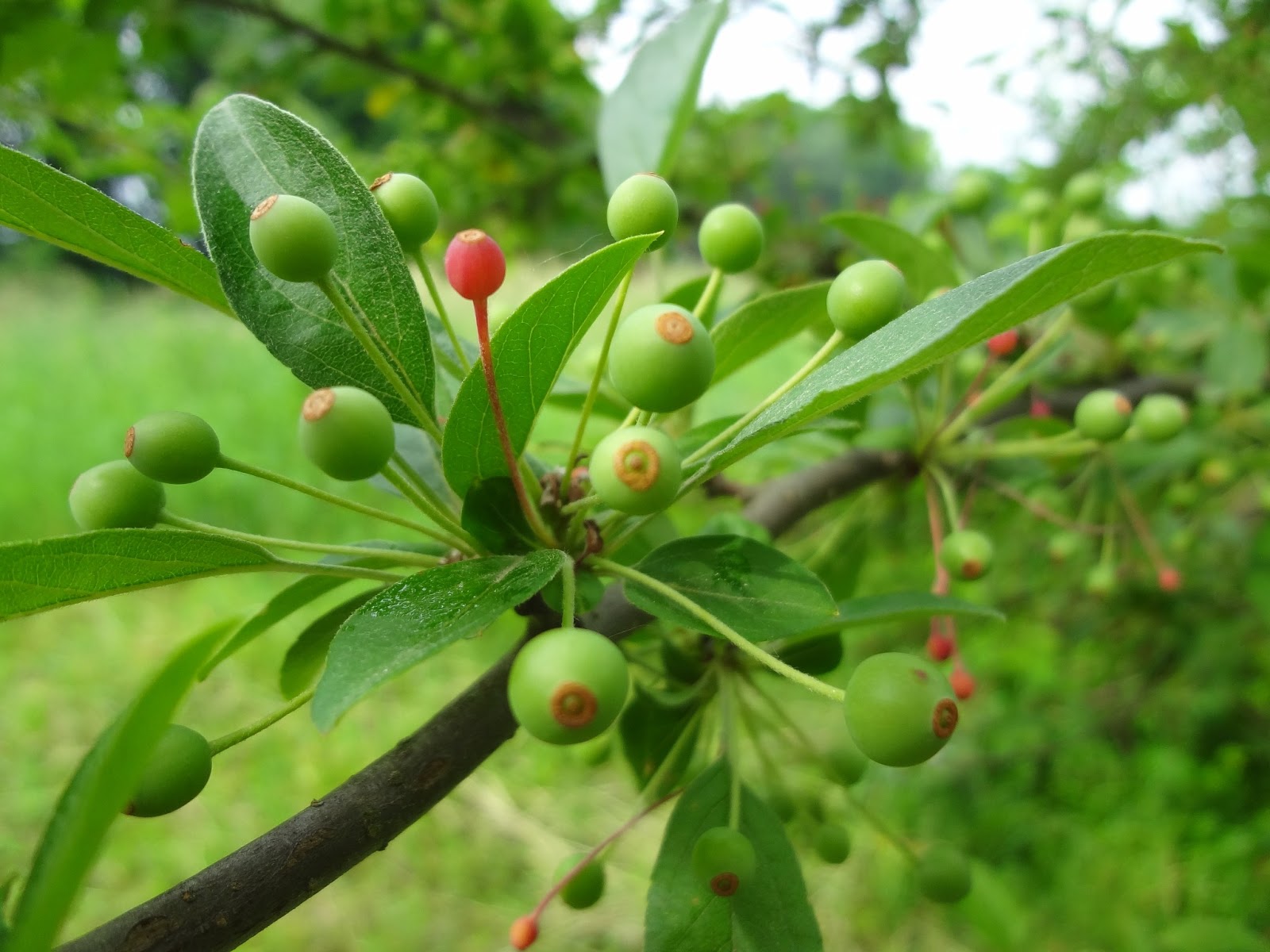
The fruit of one of my smaller fruit trees has me puzzled. They almost look like tiny  olives, don't they? Since last spring there was a hard frost that ruined all fruit on the trees, I never did get to see what grows on some of these trees. I am watching this year.


A few of my favorite bleeding hearts are still in bloom in my flower bed.


My barn is getting a beautiful green cover of ivy.


I love watching the greening trees enclose the little red farmhouse as if in a green embrace. It keeps the house surprisingly cool during hot summer days.


Guinnez takes off up the path that leads to our Cottage on the Hill, an artist's retreat I offer to creative friends but also use as a home office for myself. Guinnez knows I keep dog biscuits up there, so he never winds the uphill climb through the woods.


Guinnez settles in to rest inside the cottage and waits for me to bring the biscuits out from the cupboard.


Please? Can I have a biscuit now, please?


Guinnez surveys the woods from the deck of the cottage before we head down the path to the big old apple tree. This tree, too, had no fruit last year due to the hard frost. This year, it is heavy with fruit. I'm thinking apple pies, chutneys, applesauce ...


Gradually, I'm learning about foraging, about herbs and teas. I'm fascinated to learn about the medicinal herbs I have growing right here in my own back field. One of these is mullein. I pick a few of the velvety soft leaves to dry for teas, and it can also be used to make natural cough syrups, with antibiotic qualities.


About a year and a half into my life at Z Acres, I love my corner of paradise more than ever. It's a wonderful place to live and work, to entertain friends, to just get away from the nonsense of the supposedly civilized world. It's my forever Home.


Friday, June 07, 2013

The Father and Daughter Trash Team

by Zinta Aistars
Published in Southwest Michigan's Second Wave Media
June 6, 2013


WAYNE DEERING, RECYCLING ENTHUSIAST - ERIK HOLLADAY

Deerings get help to lighten the load of festival refuse that's landfill bound

Festival season is here. Find out how Wayne Deering and his daughter Emily are working to keep more festival trash out of the landfill. Zinta Aistars reports on their efforts.


It's a father and daughter date like none other. Wayne Deering and his daughter Emily recycle together. And they recycle big. In 2012, they collected 8,400 pounds at the Taste of Kalamazoo Festival. Of that, 1,560 pounds went into recycling, but 6,040 pounds ended up in a landfill. That last number is the one that the Deerings are working hard to shrink. 
 
"That's about 28 percent less waste that ended up in the landfill than in the previous year," says Wayne Deering. Deering, a commercial broker, and his daughter Emily, an international studies major at DePaul University in Illinois, refer to themselves as event coordinators and consultants for the festivals, and they are in their second year of collecting, recycling and composting waste at the Taste of Kalamazoo and the Kalamazoo Island Festival.
 
"I've always been interested in recycling," says the father. "Long before anyone was doing it. I do it personally--the pile of recyclables at my curbside Monday morning is far bigger than anyone else's on my street," he says with a laugh. 
 
"My dad motivates me," says the daughter. "He's the kind of person who would peel the label off a prescription bottle to put it into recycling." She echoes his laughter. 
 
Wayne Deering has been recycling since the '70s, he says, when he was a college student, but attending just one of the Kalamazoo festivals made him feel like a lifetime of responsible waste collection was erased by the mountains of trash produced in just one festival. Something had to be done. 
 
The Deerings found kindred green spirits at the I.D.E.A. Association. I.D.E.A., that's Interdisciplinary Education through Education and Art, is a nonprofit created by Matt Lechel and Mark Thompson in 2007.  
 
Lechel, now a board member and enthused volunteer for I.D.E.A. Association green efforts, was only too pleased to work with the Deering team. The role of the association is to work in collaboration with local experts to offer greening services for events, and the Deerings qualified as those local and willing experts. Along with assisting with the greening services, I.D.E.A. volunteers provide professional evaluation of all waste data from the event to measure progress over coming years and events. 
 
"We had worked on several of the festivals already," says Lechel, "beginning with the Boiling Pot Festival, and we worked up a sheet from that on what we would need to do in these two festivals. Wayne Deering was the first to respond when we looked for help. He stepped right up to the plate; I give him a lot of credit for that." 
 
Lechel has a lot of practice in doing good deeds around Kalamazoo. Along with being an adjunct professor at Western Michigan University, he is executive director of Kalamazoo Collective Housing, coordinator for Kalamazoo Neighborhood Safety Initiative, sits on the board of directors at People's Food Co-op, and volunteers as a parks commissioner. 
 
Kate Binder, Lechel's greening services sidekick, started working alongside Lechel at the Boiling Pot Festival, and she became the impetus to translate those efforts to other festivals. A recent graduate of WMU, with a master's thesis on recycling, Binder was eager to gather the data for their recycling efforts.
 
"I assembled a report to give us a baseline for measurement," Binder says. "It's a starting point for us to tweak. It's proof that this can work." 
 
Binder's report outlines how effective the Deerings recycling efforts were in collaboration with I.D.E.A. volunteers, which included Binder and Lechel standing alongside what they call "pods" of receptacles to capture trash. One receptacle holds recyclable items, the second holds compostable items, the third is destined for a landfill. Volunteers guide people to the correct receptacle, offering education in the process.
 
"The educational component is probably the most important," says Binder. "Our hope is that people will take the concept of recycling home with them."
 
"Can't tell you how many people come to us at the festivals and tell us ..."