Wednesday, August 15, 2007

A Writer Travels


When we speak of travel, we usually speak of planes, trains and automobiles. And other various modes of transportation. But writers also travel on the steam of words. Words are our engine, transporting us forward in life – or, as the case may be, sometimes also allowing us to travel back over time. Words, unlike planes, trains, and automobiles, have no time constraints, nor is any geographical location, even one that does not exist geographically, out of bounds (ask any science fiction writer). Riding on the engines of words, we are free to explore without limitation. Imagination is our vehicle of choice.


Ever since I can remember, I have been a carrier of the wild wanderlust germ. It gives me no peace. It has no known cure. For a short time, sure, I am content to stay in place, content to explore the constraints of my daily routine. But not for long. I crave travel. Planes, trains, and automobiles, even ships and hiking boots and horseback, RVs and bicycles, any mode will do. I have been traveling since earliest childhood, as acclimated to being on the road as I am to staying at home, traveling no further than my backyard deck to let my gaze alone wander the distant horizon. Comes a time, however, when I have to hit the road.


I travel with favorite travel buddies, I travel alone. A journey, any journey, changes according to how and with whom we travel. Traversing the very same miles, taking in the same scenery, my journeys have varied dramatically according to my travel companion. A road trip with Mom is not the same road trip as with my best gal pal is not the same road trip as with a cherished lover is not the same road trip as with my two babies in tow. Conversations to pass the time and the miles differ, from topic to manner of expression. Some travel companions inspire lengthy and deep-diving philosophical discussion, while others inspire prickly silent treatment, and still others, a constant sparking of laughter. We tend to see the world according to the shared experience of and with our travel companions, and they with ours, at least to some degree, and so what catches the eye of one beholder fades into oblivion for another. Traveling with my father means lingering in the local art galleries. Traveling with a co-editor meant checking out the local Irish pubs and stopping by the nifty cigar shop every town surely has if you look hard enough. Traveling with my daughter means stretching every imaginable comfort zone I have – and that is an excellent exercise. Traveling with my mother means revisiting the erring ways of my early youth along those long road miles (ouch). Traveling with a lover imbues a shimmering sweet light to every sunset that lingers long into the night.


There is purity in traveling alone. In the coming days, I am setting out on the road alone, driving nearly cross country, from Michigan to New Mexico. It's a business trip, but there is no chance of keeping this to business only. I've explored this country this way and that, north south east and west, and there is far too much beauty to view and adventure to be experienced for any trip to ever be limited to business. My heart is already picking up its pace in eager anticipation of this new journey.


By now I know that traveling alone also means an inward journey. It means I have no one to distract me from me – but me. When I think I have had just about enough of me… well, tough luck, Z, there is just more me. Which is when something interesting begins to happen…


In every journey, there comes that moment of hitting a wall. When traveling with someone, it is a moment when you think you simply can't bear another moment stuck in a plane, train, or automobile with this other person, and the scream is stifled in your gut, squeezing its way up your throat, leaking from your eyes in a misty vapor, wisps of steam curling from your ears.


Get me out of here!


But, oh, there is nothing to be done about it. Not one thing. You are a gazillion miles from home, and you can't up and leave the house and slam the door. You're stuck. (Unless you don't mind leaping from moving vehicles or skydiving from jet planes.) Deal with it. Deal with each other, and when you finally do, the brick of the wall begins to crumble. Mortar chips away and stone grinds to dust. Bricks come tumbling down and a first sliver of light shines through the cracks. On the other side awaits the exquisite intimacy reached only when two people, in whatever type of relationship, are pushed beyond their personal comfort zones into new territory… together. Words are exchanged, all kinds of words, and a new level of relationship is created.


The same phenomena applies when traveling alone. The miles accumulate, the road stretches out and beyond, and I begin to reach that outer limit of boredom with my own worn-out thoughts, daydreams already frayed at the edges, and the conversations I have with myself in my own mind circle like droning flies. All I want to do is slap them away.


It is usually at that point that I have some kind of epiphany. The thought I tried so hard not to allow in—gets in. And you know? It's not such a scary thought, after all. That demon that I've been dancing with for some years now turns out to be a poodle in a tutu, not at all so intimidating, rather silly, in fact. I deal with it and shoo it off the stage to fully enjoy the new landscape.


What travel accomplishes, aside from filling our photo albums with great shots of mountains and oceans and amusement parks and tourist traps, is an inner journey that aligns itself with the external journey. In travel, we traverse the physical geography of a landscape as we traverse the inner landscape with its own shadowy caverns and mountain peaks and roller coaster rides.


What a writer gains in travel is irreplaceable. Keeping a travel log later proves to be a writing exercise like none other. New backgrounds are gained for an endless array of creative scenery. A deeper understanding of the human psyche, one's own and that of others, is revealed in a way that daily routine forbids. A life transcribed upon the written page must first be lived. In vivid color, mile by mile, traveling in and out of oneself.


Friday, July 13, 2007

Seeing Every Word My Father Paints

Tribute to Viestarts Aistars, my father,
on his 80th birthday: July 15, 2007


Photo Sharing and Video Hosting at Photobucket


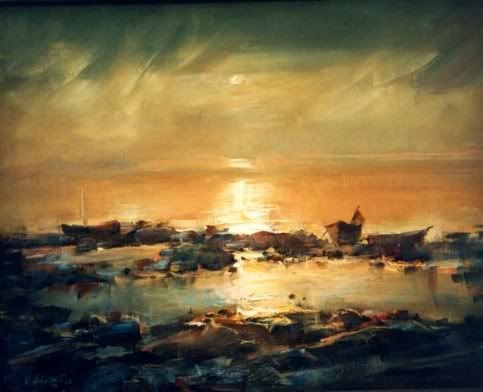
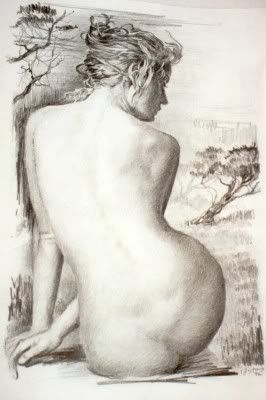
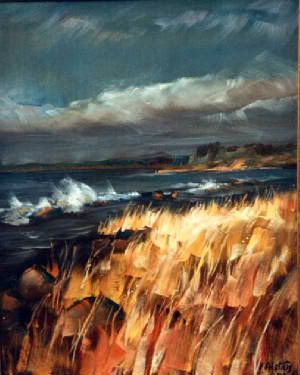
It doesn't matter that we don't speak. He paints, and with that, watching him, I hear every word. Not only the words, but the beating of his heart. I hear the whispers of a random breeze, tangling in his trees. I hear the shushing of waves, small ones, rippling against the soft, sandy shore, and the smash of the great ones, tipped with foam, breaking against the rocks. I hear the creak of old wood in his fishing boats, rusty hinges and masts that bend in the ocean gales, but never break. I hear the soft splatter of rain on his city pavement, on the curved and dripping sides of his umbrellas, blooming against the wet sky. I hear the slapping of wet laundry hanging on the line. I hear the soft, steady breathing of the reclining nude on her flowered divan, her lazy gaze lost in a book. I hear the silence, lying back in his lush gardens and endless meadows, watching his clouds bob high overhead.

I can hear him still, even if my understanding of his words, painted in vivid color on canvas, has grown more sophisticated with time – I've grown to understand something about the ups and downs of life by now, too, requiring a more deeply intoned language – and even when I have stepped away from my father's paintings, they follow me. They have followed me since my earliest childhood, through all my growing years, and now ease me across the threshold of midlife. I know, they will follow me to the very end of my path.

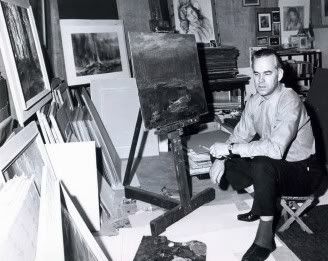
For me, the hearing translates into written words on a page. For my father, his writing tool is a paintbrush. At first glance, perhaps two very different mediums of artistic expression. But are they? My very earliest impressions of my father at work in his basement studio, when I was a little girl in long braids, peeking around the corner and careful to not make a sound so as not to disturb the magic, was of a creator at work over his many worlds. It was that process of creation—from nothing to create something, from the white and blank canvas to draw out living flesh and living things, seascapes and landscapes and figures—that so fascinated me and sold me on art. I wanted that. I wanted to create, too. Surely there was nothing more satisfying in chosen occupation! If the fathers of other little girls I knew donned business suits and knotted ties around their necks and went off to offices with briefcases in hand, surely what my father did beat all. There was nothing magical about business, I thought. Calculating numbers and filling out spreadsheets and sitting in meeting after meeting after meeting… but see, my dad! My dad worked in solitude, separated from the busyness of the world outside, hidden as all wizards are in their towers and hidden caves, and he waved his wand, his brush, across the easel, and before long, behold: a forest sprang to life. A shaft of light fell on the moss. Flowers opened fresh faces to the sun. And up from the earth sprang streams of clear water….

The fathers of my little friends could do nothing to compare to this.

So I kept on watching, and I learned from my father's medium – paint – how to paint with language. Art is creation, and I was giddy with what I had learned in seeing him paint. There was the blank white page. A fearsome thing. Silent and ungiving and patient as death. The creator could sweat and moan and writhe in the agony of uninspired creating, but the blank page, as the blank canvas, would have no mercy, give no clue, only wait, and wait, and wait. But then there was the moment, the first word as the first dab of color, that scarred the page and canvas, and it would never again be the same. Not even when erased or deleted. Juices flowed, passion turned its engines, wheels began to turn, pulleys spin, and the machinery of creation was begun. No turning back now. Using words as my tool, I soon learned my father's exhilaration. This was the elixir of the artist's intoxication, the muse, the siren, and this was, as Joseph Campbell has advised: following one's bliss.

Few compliments I have received over my writing career compare to my audience at an authors' reading telling me: "I can see what you wrote. It is as if," they might say, "you paint with words…" And I beam. The little girl in braids peeking around her father's studio door remembers, and she feels the pride of achievement of a lesson well learned.

Here is what I learned from my father, the painter: when faced with a white canvas, the blank page, think about the composition. There must be balance. To what point do you wish to draw the eye? Consider where the eye goes first, then, to what place on the canvas does it go next? And then? Keep that inner eye intrigued, don't let it slip off the page, but moving, ever moving, across all the lines and angles, taking it all in, every last detail, hungering for more, craving resolution, until at last—the picture is complete. When it is, then be sure the image haunts, and it remains long after the eyes of your audience have moved on to another spectrum. You must capture the mind, the spirit, the heart. To do this, the colors must blend with ease, but then, just when you think you've got it figured out, plotlines and paint lines in order, suddenly—a surprise! That slant of light against the dark background, oh, it fascinates, does it not? For a moment, you can't help considering what it might be like to stand inside that circle of light. To be a part of that painting. A part of that story. A main character. When what they see on the page or the canvas so resonates with the viewer and the reader, when they sense a kind of mirroring of their own experience and life sense in the art, blending so seamlessly that they do not know where the story and the painting begin, and where their own life continues on, then you know you have made a crucial connection. Your art has melded with another heart. For a moment in time, you, the artist, the viewer, the reader, are no longer alone.

Years passing, little girl unbraiding her hair to grow into the woman, and young father growing into an elderly man of accumulated wisdom and vision, more lessons transpire. There is the lesson of passion, yes, the near losing of oneself in one's art: so immersed does the artist become, falling as if into a trance, a kind of madness, delusion and illusion made real, letting go of the boundaries and limitations of reality so as to dance on the other side, yet always come back again. It is necessary. Nothing less will sustain. But there is also the lesson of persistence: the long work day concluded, the artist comes home to begin the work day all over again, this time in his studio or her study. Because even my father at some point had to go to the office. Working as a commercial artist, long before the days of computer and clip art, he drew the cows that mooed across paper milk cartons, the coupons housewives clipped in Sunday newspapers, the menus the hungry read at the downtown posh restaurant. Draining work, perhaps, making the living room couch seem that much more inviting after 5 p.m. Yet my father returned home, not one day missed, and kissed his wife soundly hello, patted both daughters on their heads, and bypassed the couch for his basement studio. It was not a drain to him. It was reinvigoration. The magical hours that made the other eight-hour nonsense make sense.

I got it. When the rejection slips came in for my first awkward poems and clumsy little stories, I didn't worry. The sting was short-lived. One had to create first in response to the voice inside. The whispers of wisdom, that divine something connected, it seemed, traveled straight up to God. Because there never really will be an explanation for art, will there? From where it comes and how it transforms and what it becomes.

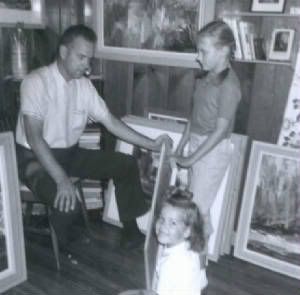
My father once told me he was sorry. When I was a grown woman, he once apologized for not spending enough of those evening hours at home with me. Or his other daughter. We played overhead (or so he thought) with our toys and other distractions while he painted below, and sometimes did not come back upstairs until long after dark, when we were tucked into bed. I widened my eyes in wonder. Sorry? Was I missing something? I, who grew up in these swirls of color perfumed with the tang of turpentine? Does one apologize for magic spells broken open to inherit and pass on?

I missed nothing. Not even the lesson that an artist must emerge from his den or studio to reenter the real world. When there was the vigor of youth and health, my father often packed up his palette and paints and folded up his wooden easel to announce: field trip! My mother packed a picnic lunch of dark Latvian bread, thick and fragrant with earthy grains, spread with real butter and lavish slices of sausage or ham, cheese, and crisp pickles. Blankets were folded into the car trunk, but I don't recall being able to sit on one. The places he took us were too rich with life. These were the worlds that lived in my father's mind, I knew, because I saw him pull them from his memory and onto the canvas in the years to come. See the sights, smell the smells, hear the sounds, taste the tastes, feel the touch of reality on our skin so that we would have something to bring home again.

So did the writer require living life before she could construct the story. It was a gathering time. A knocking about time, sustaining and surviving all its hard knocks, submitting to the bruising of life at its keenest edge, because the art created in the tucked away place later would always reflect it. Not living fully, completely, utterly, and above all courageously, would also be evident. Life had its risks, chances would have to be taken, or the connection between artist and art, viewer and reader, might never be made. To paint the breeze in the branches of the tree, my father had to now and then go out into the field and feel it on his own skin. To paint the shining ripple on the water, my father had to roll up his pant legs and wade in. I, too, had to live my life before it could transcribe it. The rejection slips no longer came so frequently. Submission accepted. I gotit.

I got it, Dad. How the paint flows in your bloodstream. Now the words flow in mine. As your basement studio, so now my secluded den. I tap away at the keyboard as you dab away at the canvas. From the white page emerges something living that did not live before, and you planted that seed, that love of the art, that drive to create. I swirl a slant of light into my poem and I think of your forests and the sun breaking through. I paint with words because you taught me to see.


Viestarts Aistars is a painter whose favorite mediums are watercolor, oil, and an ordinary pencil. He has had over 50 one-man shows across the United States and in his homeland Latvia, and his art has won numerous prizes and critical acclaim. One of his paintings was purchased by the president of Latvia and now hangs in the presidential residence in Riga, Latvia.

Zinta Aistars is a writer and editor who has had three books published in the Latvian language, now seeking a publisher for her first collection of poetry in English. She is on the editorial board of the literary ezine, insolent rudder; a poetry editor for the international women's literary ezine, Her Circle Ezine; and the managing editor of The Smoking Poet.


..Photo Sharing and Video Hosting at Photobucket">


..Photo Sharing and Video Hosting at Photobucket">


..Photo Sharing and Video Hosting at Photobucket">


..Photo Sharing and Video Hosting at Photobucket">


..Photo Sharing and Video Hosting at Photobucket">


..Photo Sharing and Video Hosting at Photobucket">


.
Daudz laimes, Tet. Daudz baltu dieninu...

Monday, June 11, 2007

Cranreuch Palpitations

by Zinta Aistars


With first humid hints of summer heat,
I am already molten with misery –
a polar ice creature of northern inclinations
meant only for a glacial love.
My heart shimmers with a rime
of jagged-edged hoarfrost stars
at the first blue blink of my lover's cool face.
My icy hands quake at his shuddering sides,
knuckling a frigid rib cage
where a gelid pulse knocks loose
prickling icicles of frosted flatteries:
I love you best in chilblains,
I nip you loose with frostbite,
I shiver your bones to a snowy white,
the snap of a Siberian gust binding
a jewelling of diamond ice chips
to your stiffened lashes, your sweet sherbet mustache,
the fine, golden hairs of your reaching arms
turned platinum and shining silver.
Enfold me in a white flurry,
blizzard my kisses into goose flesh,
warm me to crystal ice, my ice into white-flamed warm,
a hailstone storm of pooling fresh melt
of arctic joy.
I shall not love again until winter.


.