Friday, January 08, 2016

Between the Lines: Writing Through Grief

by Zinta Aistars
for WMUK 102.1 FM
Southwest Michigan's NPR affiliate


Between the Lines is my weekly radio show about books and writers with a Michigan connection. It airs every Tuesday at 7:50 a.m., 11:55 a.m., and 4:20 p.m. (or listen anytime online), on WMUK 102.1 FM, Southwest Michigan's NPR affiliate. I am the host of Between the Lines.

This week's guests: Mira Ptacin


The pregnancy was unplanned. The boyfriend was new. Mira Ptacin wasn’t sure she was ready for any of this, but it was too late to back out now. After all, she was in love with Andrew; she was 28; and why not accept his proposal for marriage? Everything was going to be just fine. Even if she did just cancel her health insurance. But everything was not fine.

Ptacin’s memoir Poor Your Soul (Penguin Random House, 2016), recounts her experience of grief and loss at finding out from an ultrasound that her unborn baby had serious birth defects and could not survive outside the womb. Ptacin had three options: end the pregnancy, induce early delivery, or wait and inevitably miscarry.

While Ptacin struggled with losing her child, her parents tried to cope with the sudden loss of Ptacin’s brother, 14-year-old Julian, who was killed by a drunken driver. Tragedy seemed to hit Ptacin from all sides.
Mira Ptacin
CREDIT SHANE THOMAS MCMILLAN
Ptacin is a Battle Creek-native and a graduate of Western Michigan University who deals with social issues as she deals with personal issues. Her book describes what happens when a woman who's expecting and faces the complication of having no health insurance. She addresses the lack of empathy shown to a woman who has had to terminate a pregnancy or gone through a miscarriage by friends in her inner circle as well as society in general. She writes about the irony of growing up Catholic and having a father, a medical doctor and former seminarian, guide her through the end of her pregnancy.
As part of her concern for the social welfare of women, Ptacin teaches memoir-writing at the Maine Correctional Facility, near her home in Portland. She says sharing her story with the women imprisoned there has been especially meaningful.
CREDIT RANDOM HOUSE
“These women have often endured hardship all their lives. They end up in prison because of ...

Thursday, December 31, 2015

Between the Lines: The Typewriter Revolution

by Zinta Aistars
for WMUK 102.1 FM
Southwest Michigan's NPR affiliate


Between the Lines is my weekly radio show about books and writers with a Michigan connection. It airs every Tuesday at 7:50 a.m., 11:55 a.m., and 4:20 p.m. (or listen anytime online), on WMUK 102.1 FM, Southwest Michigan's NPR affiliate. I am the host of Between the Lines.

This week's guests: Richard Polt


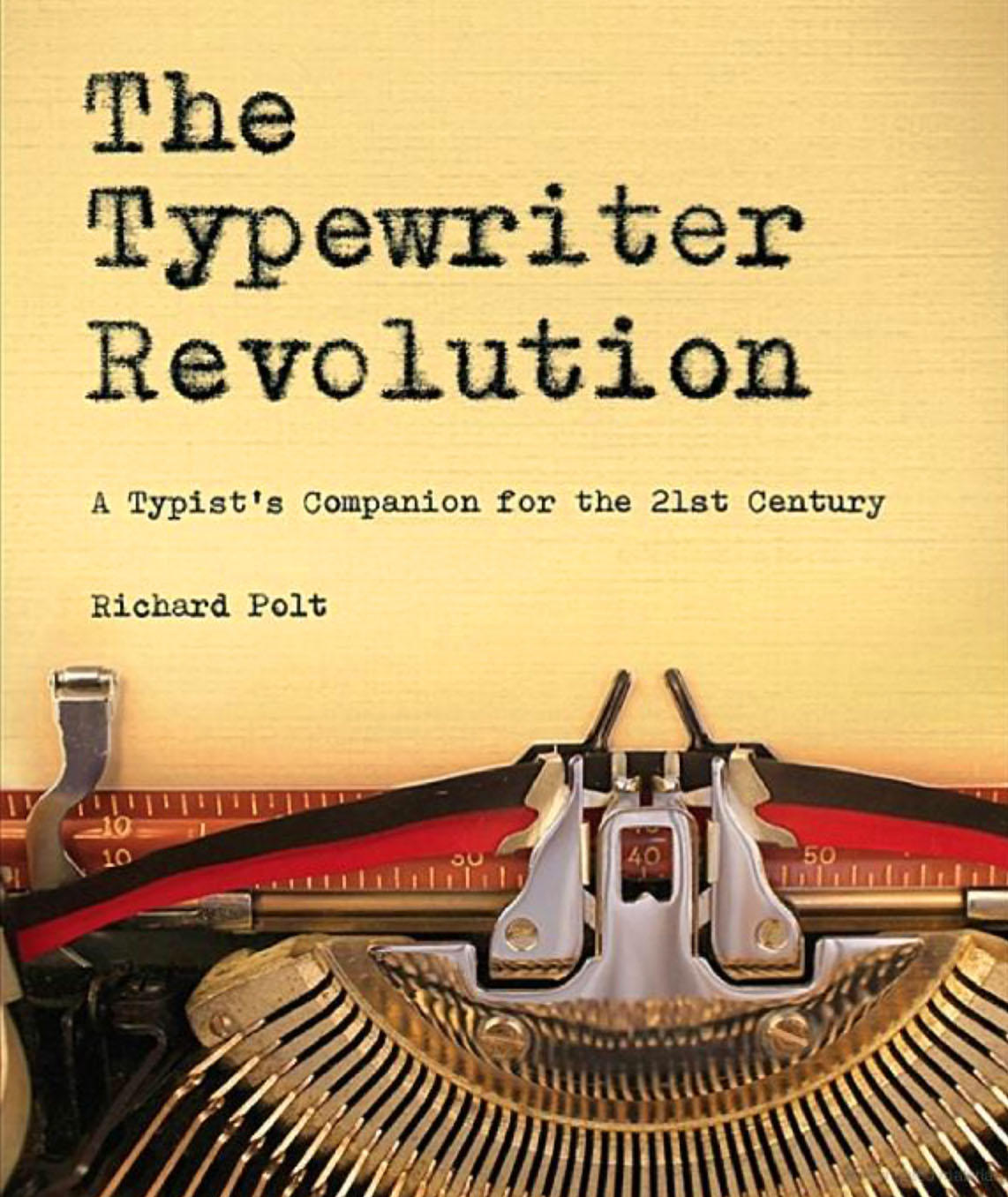
Why would anyone these days who needs to write reach for a typewriter? Aren’t computers much more efficient? They are and author Richard Polt says that’s precisely the problem. Polt is a professor of philosophy at Xavier University in Cincinnati, Ohio, who says the typewriter is making a resurgence, if not a revolution, in our time. He’s written about this phenomenon in The Typewriter Revolution: A Typist’s Companion for the 21st Century (The Countryman Press, 2015).

Dig deep and you will find a patent for an invention that looks much like a modern typewriter as far back as 1714. English inventor Henry Mill filed his patent, describing his invention as "an artificial machine or method for the impressing or transcribing of letters singly or progressively one after another." By the 1870s, typewriters could be found in a few business offices and in some homes too. The typewriter was a modern and much-used machine in the 19th century—but does it have a place in the 21st?

Polt’s interest in typewriters as a collector (he owns about 300 of them), enthusiast, repairman, writer/blogger and magazine editor goes beyond the romance of using a vintage machine. He opens his book with The Typewriter Manifesto. It’s typewritten, of course: 
CREDIT THE COUNTRYMAN PRESS
“We assert our right to resist the Paradigm, to rebel against the Information Regime, to escape the Data Stream. We strike a blow for self-reliance, privacy, and coherence against dependency, surveillance, and disintegration. We affirm the written word and written thought against multimedia, multitasking, and the meme. We choose the real over representation, the physical over the digital, the durable over the unsustainable, the self-sufficient over the efficient. THE REVOLUTION WILL BE TYPEWRITTEN.”
“It’s not just about nostalgia,” Polt says. “As the digitization of the world races forward — challenging our privacy, our powers of concentration and our self-reliance — it becomes ever more important to find ways to stay connected to physical reality. That’s why I call the typewriter revival an insurgency against the all-digital paradigm.”
Writing on a typewriter, Polt says, gets us ...


Tuesday, December 29, 2015

Fit and Trim Through the Winter Chill

by Zinta Aistars
Published in Welcome Home Magazine
Winter 2015 Issue


As the holiday season begins, motivation to maintain fitness routines wavers. The ice and snow of Michigan winters make walking, running or biking challenging if not dangerous. Driving to the gym when roads are slick makes a longer sit on the couch, potato chip bag in hand, that much more enticing.

“Typically, people gain one to 10 pounds over the six weeks of the holiday season,” says Kim Brockway, owner of Veritas Fitness, located at The Courthouse Athletic Center, 7365 Sprinkle Road in Portage. “Holidays are goal destructors! People tell themselves they will make up for all that holiday eating after the New Year, but too often that doesn’t happen.”

Brockway has been a personal trainer since 2008, and she opened Veritas Fitness in 2013. “Veritas” is Latin for truth, and Brockway encourages members to remain true to their health and fitness goals. She is ready with advice to make sure members stay stick with their good intentions through the winter.

As for the bountiful holiday table, she says: “Watch portion sizes, of course, but the best advice is to drink 16 ounces of water before you sit down to your meal. Even if you change nothing else, over 12 weeks of drinking all that water before a meal, on average you can lose 5 to 10 pounds.”

Better yet, Brockway advises, find an accountability buddy and check in with that person every day, whether a friend or personal trainer, and not just an app on your phone or other form of technology. Share your exercise with a real person.

“If you only have 40 minutes, do some strength training rather than cardio,” she says. “While cardio can burn more calories quickly, strength training such as squats, push-ups, or using dumbbells will give you a long-term burn. Find something new to do so you don’t get bored.”

Veritas offers a variety of workout boot camps, personal trainers who work with your unique fitness goals, and meal plans for those on the go.

While West Hills Athletic Club at 2001 South 11th Street in Kalamazoo is owned by Western Michigan University, only about a quarter of its 4,000 members have an association with the university, says Tyler Norman, fitness director.

“We’re a full-service athletic club, in business for more than 40 years,” Norman says. He is an exercise specialist, certified by the American College of Sports Medicine. “That’s the gold standard in the industry.”

The most common mistake Norman says that he sees among those working to achieve their fitness goals “is that people don’t have enough protein in their diets, especially when doing strength training.”

Norman encourages his clients to exercise consistently—and that includes throughout the holidays.

“Strength training, weight lifting, any kind of resistance training is great,” he says. “But the most important thing is to do some activity every day for at least 30 minutes. Do strength training twice a week if you’re beginning and work up to three or four times a week if you are more advanced.”

With his long career in the health club industry, Norman says he’s observed a healthy evolution.

“It’s not just the wealthy who are now joining health clubs,” he says. “Health clubs have become very affordable for all kinds of budgets, while personal trainers maximize the effectiveness of your workout, tailor it to your goals, and that eliminates the risk of injury while keeping you motivated and accountable.”

Celebrating 30 years of keeping exercisers looking good and providing the equipment needed for the chosen sport or activity, Gazelle Sports was founded downtown Kalamazoo, but has now expanded to Holland, Grand Rapids, and Northville. Gazelle Sports often sponsors community events, training programs, weekly clinics, and runs and walks.

“Keep moving! Don’t let winter keep you inside, but dress appropriately for the weather,” says Chris Lampen-Crowell, founder and co-owner of Gazelle Sports. “Exercising is more fun with an exercise buddy, and don’t forget your pet can be that buddy, too.”

Lampen-Crowell reminds customers to wear light colors as winter days are short. “Add something reflective that blinks, or you can look like a lamp post rather than a person. We have materials now that move moisture away from your body to maintain your core temperature, so you don’t have to dress in heavy coats to stay warm. Footwear like Yaktrax have small cleats on the bottom to keep you safe on ice—tumbles aren’t fun.”

Lampen-Crowell has a recommendation for starting the New Year on the right foot—with the John Daley One-One Run at Spring Valley Park, Kalamazoo, on January 1, 2016.

“It’s a great way to start the year, and you don’t even have to get up early. It begins at 1 p.m.,” he says. “It’s just 2.2 miles, and you can walk it or run it. It’s a fundraiser for the Boys & Girls Clubs of greater Kalamazoo, so you can help others while having fun and staying fit.”