Thursday, December 17, 2015

Galesburg Meat Company changes to meet customers' needs

by Zinta Aistars
Published in Southwest Michigan's Second Wave Media
December 17, 2015


Jena, left, and Arlene Christian at GMC


When Jena Christian was a little girl, she remembers her father coming home from work in his long white butcher's apron, splattered with red. 

"It's Kool-Aid, honey," her father would say. 

Sitting in the back office at Galesburg Meat Company, Jena, now a grown woman, laughs heartily. Across from her, sitting at the desk, is Arlene Christian, her grandmother. Three generations of Christians have owned and managed GMC since Rich Christian, Arlene's husband, bought the business in 1977. When Rich passed, he left the business in his son Mark's capable hands -- and "Kool-Aid" splattered apron. 

"Rich was the meat manager at the Family Foods grocery store in Kalamazoo back then," Arlene says. "Someone told him about Galesburg Frozen Food Locker going up for sale, and he bought it. He was the sole proprietor then, but we incorporated about 30 years ago."

When Rich Christian took over the business at 58 Mill Street in the center of Galesburg, he changed the name to Galesburg Locker & Meat Company. At that time, Arlene explains, few people had the refrigerator space to hold a side of beef, which was what the business sold. Once the side of beef was purchased -- sometimes even financed through a bank -- it was stored in a locker. As times changed and more customers bought larger freezers of their own, the "locker" part of the business was dropped, and the name was shortened to Galesburg Meat Company.

Today's GMC sells much more than sides of beef. To beef add pork, poultry, seafood, smoked meats, along with seasonings, cheeses, sausages, and homemade jerky. Meats are sold in quantities of one-meal up to, yes, sides of beef. 

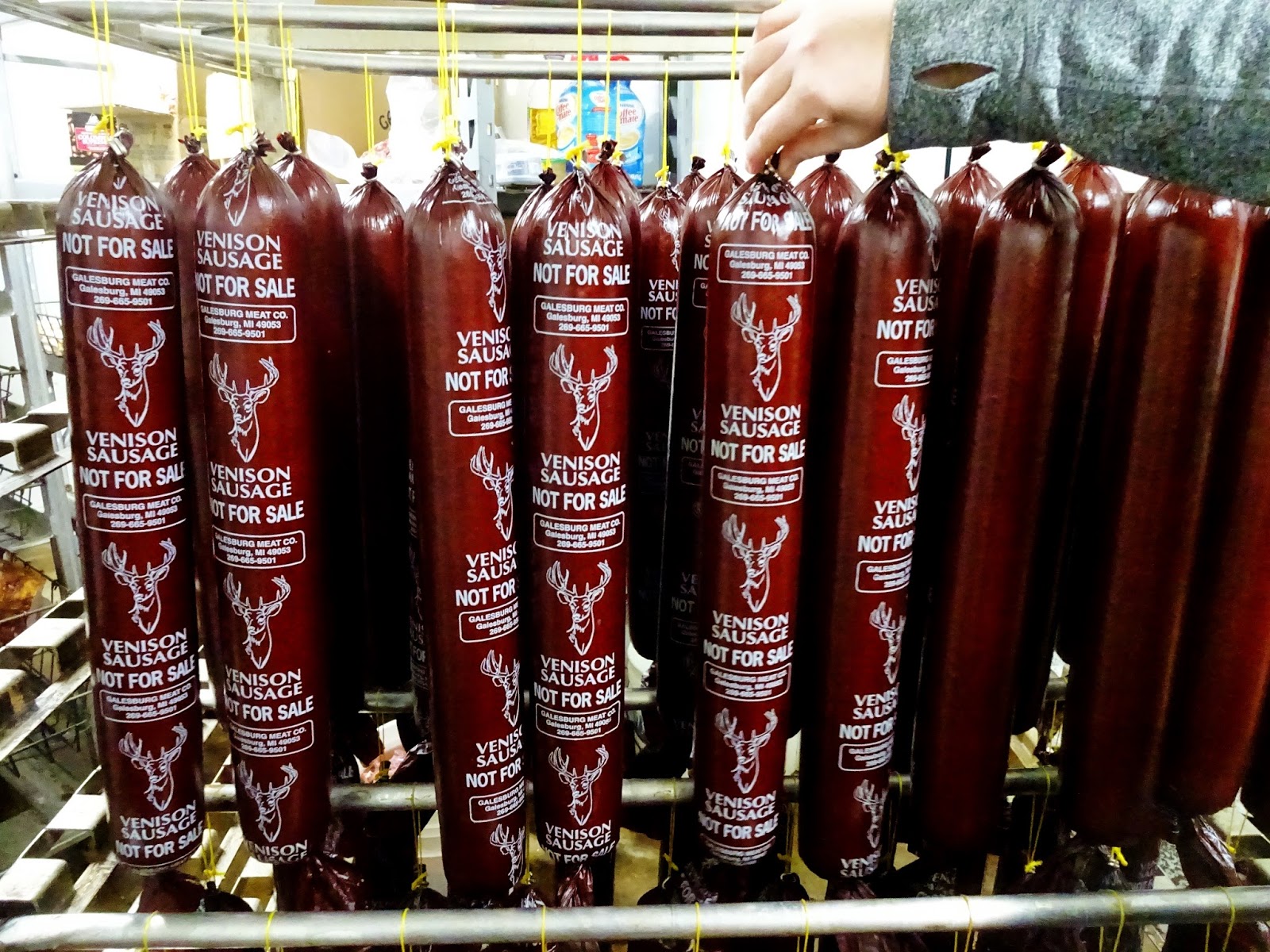
"We used to also process venison, but we stopped doing that about three years ago," Jena says. "Regulations for handling deer are complex and now require a separate building. We didn't have the space. But if someone brings in a boneless piece of venison, we will still process that." She points to a long row of venison salami swinging from a rack, ready to slice. 

What differentiates GMC from your corner supermarket, the Christians will tell you, is that to this day they are still an old-fashioned butcher shop. Meat arrives at the supermarket already packaged, but buying meat from the butcher means the customer knows exactly how fresh that cut is -- and where it is from.

"All our beef and pork is local, all from farms within five miles down the road," Jena says. "We process meat from farmers, from slaughter to packaging, or we do custom processing when someone buys from a farmer and wants it processed a certain way."

Another family tradition, passed from generation to generation, is how  ...

READ THE COMPLETE ARTICLE AT SECOND WAVE.

Pork belly

Bacon

Jena demonstrates tumbler

Smoke house

Venison salami

Mark Christian

Making sausage

Tuesday, December 15, 2015

Between the Lines: InsideOut Reaches Kids

by Zinta Aistars
for WMUK 102.1 FM
Southwest Michigan's NPR affiliate


Between the Lines is my weekly radio show about books and writers with a Michigan connection. It airs every Tuesday at 7:50 a.m., 11:55 a.m., and 4:20 p.m. (or listen anytime online), on WMUK 102.1 FM, Southwest Michigan's NPR affiliate. I am the host of Between the Lines.

This week's guests: Peter Markus and Nandi Comer

Nandi Comer and Peter Markus
CREDIT NICHOLE CHRISTIAN


Schools across the country have been dealing with financial pressure by cutting spending on the arts. But since 1995 in Detroit, the InsideOut Literary Arts Project has been sending writers to schools throughout the city. It's now in 30 schools. Over the years it has introduced many thousands of students from kindergarten to high school seniors to the literary arts.

The project was founded by Terry Blackhawk, a teacher who wanted to help students overcome obstacles to self- expression. With her was senior writer Peter Markus. And one of the students in the beginning, Nandi Comer, is today a writer-in-residence, teaching the next generation of students.
Peter Markus says, “Our job, whether or not we are met with resistance, is to get the students to see that they can do what we are asking them to do. We put them into situations where they can see that isn’t quite as daunting to write a poem as they thought it might be. Many of them have never written a poem before.”
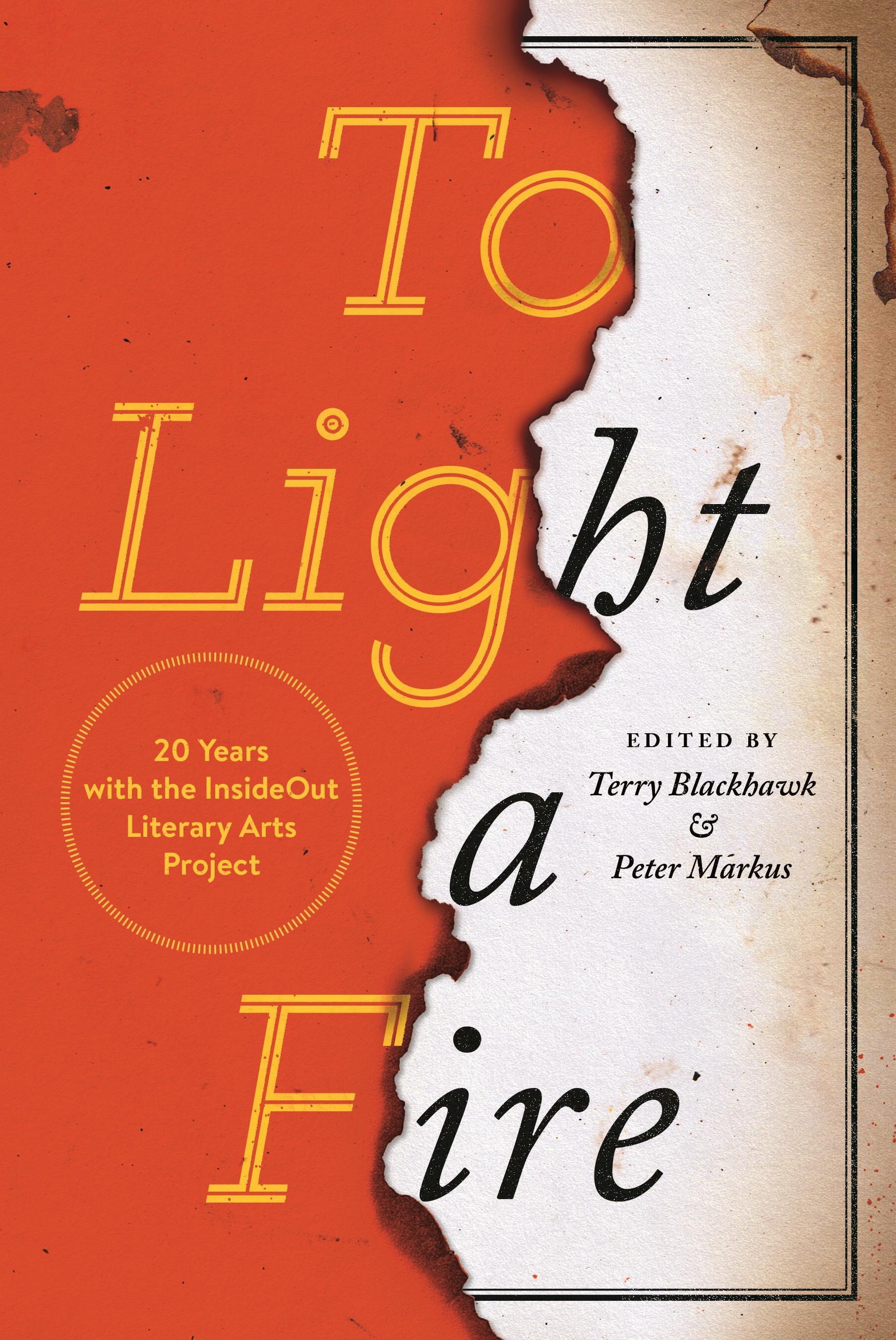
The anthology To Light a Fire: 20 Years with the InsideOut Literary Arts Project (Wayne State University Press, Made in Michigan Writers Series, 2015), includes essays from poets and writers like John Rybicki, Jamaal May, Robert Fanning, francine j. harris, Isaac Miller, Nandi Comer, and many others, about their experiences working with students.
InsideOut's success in Detroit has won national attention. It's been feature in a public television program. And it won a recent award from the White House: the National Arts and Humanities Youth Program Award, presented by Michelle Obama.
CREDIT WAYNE STATE UNIVERSITY PRESS
The First Lady said in her opening remarks at the award ceremony...


Thursday, December 03, 2015

Equity, inclusion and hope on the West Side of Grand Rapids

By Zinta Aistars
Published in Rapid Growth Media
December 3, 2015


From left, Sergio Cira Reyes, Andrew Sisson, Karl Williams and Katie Booms.
Photo by Adam Bird


It’s been called the gold rush of Grand Rapids’ West Side. Recent projects in the area include an expansion of Harmony Brewing Company, a mixed-use development called Fulton Place, and Lofts on Alabama from the 616 Development, LLC. It’s a gold rush, however, that makes residents feel on edge.

“That’s why we are here,” says Sergio Cira-Reyes, project director at Westown Collaborative. “We want the residents of the West Side to feel that all this development isn’t something that is happening to them, but that they are a part of it.”

Westown Collaborative, Cira-Reyes explains, is a collaborative of organizations that support the residents and causes of the Westown community. The collaborative was founded in 2011 to bring equity, inclusion and hope to the West Side.

Facilitated with the help of Asset Based Community Development (ABCD) consultant Wayne Squires, funding for the collaborative was sought from the W.K. Kellogg Foundation, Grand Rapids Community Foundation, and several other organizations. Partners now include Other Way Ministries, Westown Jubilee Housing, Habitat for Humanity Kent County, Servants Community Church, the Grand Rapids Public Library, Gold Avenue Church, John Ball Area Neighbors, Esperanza Covenant Church, Downtown YMCA, Bridge Street House of Prayer, Keystone Community Church, West Grand Neighborhood Organization, and other groups.

“We want to redefine what it means to be a good neighbor,” Cira-Reyes says. “We welcome new businesses coming in, and we want to connect with them. A part of that is raising their awareness about how their projects affect the community.”

Here’s the challenge, he says. Where there used to be “mom ‘n pop” shops and businesses, large developments have been replacing them. Houses that were once owned by individuals and families—and sometimes rented out by them—are now often owned by people living in other areas, and rental properties are run by property management companies. Their goal is to earn top dollar for the property owner.

Andrew Sisson, Westown Collaborative community connector, joins the conversation.

“Currently the market rate for a studio apartment is about $1,000 a month,” he says. “That’s bringing in wealthier residents, and that means people living here are being forced out. About 40 percent of those living in these neighborhoods have incomes below the poverty level. People with children are having a hard time renting, because kids are hard on a house and the new owners don’t want to rent to them. And those who lost their houses in 2008 to foreclosure — the majority of those were sold to investors with cash, buying up single family housing and turning them into rental homes.”

Minorities and immigrant populations are particularly hard-hit, Cira-Reyes and Sisson state, while those with felonies in their histories are unable to find a place to live, let alone a living.

“Someone with a felony may have to show an income three times that of anyone else renting the same apartment,” Sisson says.

But that’s why Westown Collaborative ...

READ THE COMPLETE ARTICLE AT RAPID GROWTH MEDIA.